

Have you ever wondered how your MD determines if your blood work's limited cellular nutritional results are "normal" or not? It's largely determined not by Canadian authorities but by the USA's National Academy of Medicine.The truth is many are not aware that medical doctors are not trained in cellular nutrition which is far, far more than simply "a diet" or "a balanced diet" which what many medical practitioners mistakenly recommend to many patients. The reason there's no such thing as a "balanced diet" is because we're all unique and if we analyze the gamut of the terrain of the human body -- like a botanist does for a plant -- we'd likely help prevent and treat existing conditions with cellular nutrition.
Shiv Chopra (the man with the book in the header image) was never one to shy away from controversy. He embraced it with open arms, ready to take on any challenge that came his way. As a government scientist, he believed it was his duty to speak up when the evidence pointed to potential risks in Canada's food system caused by drugs used for animals. Back in 1989, he fearlessly ignited a heated discussion surrounding Canada's veterinary drug approval process. Alongside his colleague Margaret Haydon, Shiv testified before a Senate committee, revealing the immense pressure they faced to authorize bovine growth hormone (BGH). This hormone was designed to enhance milk production in dairy cows, but Shiv's unwavering dedication to food safety compelled him to raise concerns.
Cellular nutritional deficiencies can significantly affect your health and overall wellbeing. Blood tests serve as a valuable tool to pinpoint any potential deficiencies and steer you toward appropriate dietary changes or supplements -- however they are severely limited because they are a "snap shot inn time" and are poor representations of the cellular nutritional status of your body. However, it's crucial to keep in mind that these tests should complement other health evaluations and professional guidance, as they do have certain limitations. By collaborating with a healthcare provider and gaining a solid understanding of the elemental composition of your body, you can proactively enhance your nutritional health and boost your overall wellness.
Table Of Contents
How frequently do we connect the dots between medical laboratory tests conducted in a doctor's office and the food we consume, our living and working environments, as well as our lifestyle choices and social interactions? In reality, there is often a disconnect in the sterile atmosphere of a doctor's office, where the primary focus tends to be on immediate health concerns, such as diagnosing illnesses, with minimal explanation or educational resources provided. It's worth noting that the term "Doctor" actually means teacher, yet how often do we find ourselves receiving any form of educational insight from medical professionals like doctors, nurses, dentists, psychologists, or optometrists, especially when they are often constrained by budget limitations?
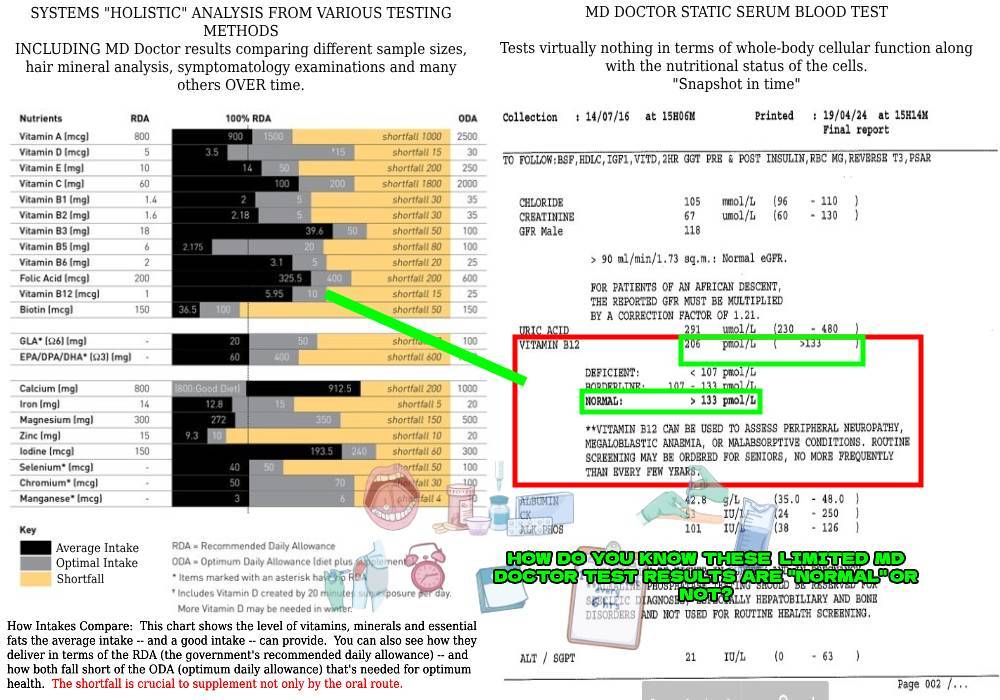
Thank you for your inquiry. In Canada, Vitamin B12 deficiency is generally indicated by serum vitamin B12 concentrations less than 148 pmol/L. This value was set by the National Academy of Medicine (formerly the Institute of Medicine) in the United States that develops the dietary reference intake value for both countries. You can find information on how they developed these values here:
Institute of Medicine. DRI dietary reference intakes for thiamine, riboflavin, niacin, vitamin B6, folate, vitamin B12, pantothenic acid, biotin, and choline [Internet]. Washington DC: National Academy Press; 1998. Available from: NCBI
The information here is that only Vitamin B12 is provided but what about all the others including essential fatty acids, minerals, amino acids (proteins) and many others?
Our bodies rely on 13 crucial vitamins to operate efficiently and these are: Vitamin A, Vitamin C, Vitamin D, Vitamin E, Vitamin K, Vitamin B1 (thiamine), Vitamin B2 (riboflavin), Vitamin B3 (niacin), Vitamin B6 (pyridoxine), Vitamin B12 (cyanocobalamin), Pantothenic acid (B5), Biotin (B7), Folate (folic acid or B9). These vitamins are organic compounds that are primarily obtained from the foods we consume but are interactive, synergististic, amplified and blocked with and by many minerals, toxins, beneficial substances, organ systems. Therefore it's not as easy as "taking a supplement" by guessing to determine what you need.
The minerals play a crucial role in your body's natural antioxidant system. Antioxidant enzymes like superoxide dismutase, catalase, and glutathione all rely on minerals to function effectively. When there is an imbalance or disruption in these minerals, it can lead to a disarray in your antioxidant system. Additionally, the accumulation of metals further complicates the issue, creating a vicious cycle that is challenging to reverse. It's worth noting that there is a significant body of literature supporting the idea that inflammation and oxidative stress contribute to conditions like depression. This is a widely accepted finding and not a controversial topic. Considering that the antioxidant system forms the foundation of your body's defense against oxidative stress, it is reasonable to assume that mental health conditions, particularly depression, may be linked to inflammation stemming from this imbalance.
They are required in optimal amounts and this varies between individuals and they are vital for sustaining life. Each of these essential vitamins and nutrients serves significant purposes in our bodies, including aiding digestion, maintaining vision, supporting nerve function, promoting bone health, and bolstering our immune system. Vitamins can be categorized into two groups: water-soluble and fat-soluble.
A reference range defines the upper and lower limits of what is considered normal. These ranges are determined by analyzing the test results of a large population of individuals called a sample size. It's important to note that different groups of people may have different reference ranges for the same test and this holds especially true in countries with longer lived, healthier populations such as Japan and Korea where tissue testing standards on biomarkers are of a much higher standard. It's typically described as the range of values where 95 percent of the average population lies (also known as the 95% prediction interval), this parameter is established through the analysis of extensive laboratory test data.
The problem with this reply from Health Canada are many. One of them is this is only the range they consider "normal" according to a serum blood test which is only a literal snap shot in time as all blood tests are and can't measure a reliable average over time due to variations listed below.
This is the confusing propaganda that misleads us all

There's no such thing as a "balanced diet" & nutrition isn't merely food. Why is that? It's because we're all individuals. Orthomolecular nutrition is the individualized analysis application of the substances within the food which our bodies often do not obtain enough of and are often blocked by antagonists.
"Nutrition" is far more than merely the trivial concept of food.
Botanists analyze the terrain to help plants prevent and restore cell function. Why not for humans?
What are YOUR individual cell nutritional imbalances?
The other problem with the above information is that the medical system including doctors, nurses and those who run these limited blood tests do not test the full gamut of cellular nutritional biomarkers such as all the other vitamins, minerals, amino acids, minerals.
Blood tests are notoriously misleading: there are other, in-expensive assessments combined to make it more "holistic"
It's only your health, right? So why become apathetic and give up or follow generalized advice from so-called celebrity internet personalities?
Blood levels can be somewhat helpful, but they can also be quite misleading. The reason for this is that they can vary significantly from day to day, depending on what you've recently eaten, even within the past few days. This means that you may end up with a lot of inaccurate high or low readings, which won't give you a reliable average. The turnover rate of blood is relatively high, so it's constantly changing.
This is mainly because blood is technically a connective fluid!
A good "rule of thumb" is to follow the lead of other countries with visibly healthier, longer-lived populations such as Japan. As an example in the 1980s they raised their reference range interval to well beyond what is considered "normal" for this nutrient from the practically non-existent above mentioned guideline of 140 pmol/Liter to more than 1000 pmol/Liter. Again, the problem here is that is only B12, but this nutrient is extremely important for the whole body but especially the entire nervous system which is extremely important for intestinal gut health and the gut-brain axis.
On the other hand, hair is a different story. Once it's deposited, it stays there, providing you with solid data for two to three weeks. This continuous data collection happens around the clock, unlike blood levels that can fluctuate greatly based on your diet.
This is not "quackery"
Nutritional insufficiency refers to an inadequate intake of nutrients, falling below the estimated average requirement. On the other hand, nutritional deficiency involves significantly reduced levels of one or more nutrients, impairing the body's normal functions and increasing the risk of various diseases like cancer, diabetes, and heart disease. To assess nutrient intake and dietary exposure, nutritional biomarkers such as serum or plasma levels of folate, vitamin C, B vitamins, vitamin D, selenium, copper, and zinc can be utilized. (source)
Deficiencies in macronutrients can lead to conditions like kwashiorkor, marasmus, ketosis, growth retardation, impaired wound healing, and increased susceptibility to infections. On the other hand, deficiencies in micronutrients such as iron, folate, zinc, iodine, and vitamin A can result in intellectual impairment, poor growth, complications during pregnancy and childbirth, degenerative diseases associated with aging, and higher rates of morbidity and mortality. It is crucial to prevent both macro- and micronutrient deficiencies, which can be achieved through supplementation and food-based approaches.
How do you know what your individual requirements are and if there are blockages?
The thing is you don't until you receive an individualized assessment by a competent systems biology practitioner specializing in cellular nutrition. Why is that? because we're all individuals and most of us can't be explained by merely statistics on a bell curve with a very limited "snap shot in time" blood test that identifies virtually no cellular nutritional biomarkers including toxicities, allergies and many other factors.
References:
National Library Of Medicine: Main nutritional deficiencies
https://food.ec.europa.eu/system/files/2020-12/sci-com_scf_out89.pdf