
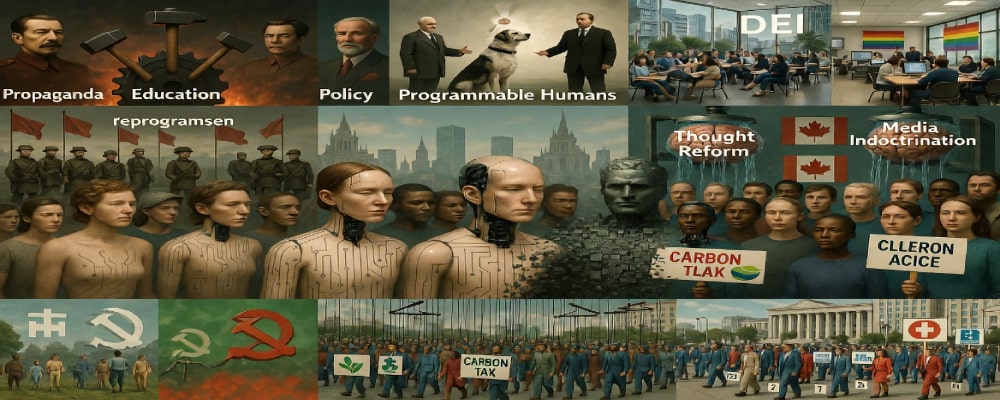
In the annals of communist ideology, a recurring theme emerges: the view of humans not as autonomous individuals with inherent dignity, but as malleable entities—programmable robots, if you will—that can be reshaped to serve the collective will of the state. This perspective, deeply rooted in Marxist-Leninist thought, manifested most starkly in the 20th century through figures and regimes that sought to engineer society by reprogramming its human components. Ivan Pavlov, the Russian physiologist famous for his conditioning experiments, provided the scientific veneer for this approach (Pavlov, n.d.). In the USSR during the 1920s and 1930s, Pavlovian psychology was weaponized to "reforge" (perekovka) individuals, treating human behavior as a series of reflexes that could be conditioned through environmental stimuli, much like training animals. Soviet educators and psychologists explicitly aimed to mold citizens into loyal proletarians, erasing bourgeois tendencies through mass indoctrination.
Leon Trotsky amplified this in his 1924 work Literature and Revolution, envisioning a communist future where humanity would undergo "radical transformation" via "artificial selection and psychophysical training" (Trotsky, 2007). He proclaimed that man would "master his own feelings, raise his instincts to consciousness," elevating the average person to the level of an Aristotle or Marx through deliberate engineering (Trotsky, 2007). This wasn't mere rhetoric; it reflected a belief in humans as raw material, programmable for utopian ends. Joseph Stalin operationalized this on a grand scale with the "New Soviet Man" (Novy Sovetsky Chelovek), an archetype of the ideal communist citizen forged through propaganda, education, and the Gulag system (Barnes, 2024). The labor camps were officially framed as reprogramming facilities, where dissidents and criminals were "reforged" into productive, ideologically correct beings (Hoover Institution, 2022). Millions endured this brutal process, their personalities shattered and rebuilt to align with state directives.
Mao Zedong in China took it further with "thought reform" (sixiang gaizao) during the Cultural Revolution. Struggle sessions and brainwashing (xinao, literally "washing the brain") were designed to erase individualistic or bourgeois traits, installing collectivist programming instead (Chen, 2024). Survivors described it as a mechanical overwriting of the mind, turning people into interchangeable cogs in the revolutionary machine (Smithsonian Magazine, 2017). In North Korea, under Kim Il-sung and his successors, Juche ideology mandates "molding" citizens through the "three revolutions" (ideological, technical, cultural), using terms like "human remodeling" to describe the process of tempering individuals into perfect, obedient tools of the regime (Britannica, n.d.). Even Soviet psychiatrists like Andrei Snezhnevsky pathologized dissent as "sluggish schizophrenia," subjecting opponents to drug-induced reprogramming to restore "correct" communist thinking (Snezhnevsky, n.d.; Medical News Today, 2022).
Table Of Contents
These historical precedents reveal communism's core tenet: human nature is not fixed but infinitely plastic, amenable to social engineering for the greater good. While Marx and Engels laid the philosophical groundwork by emphasizing material conditions shaping consciousness, their successors applied it with ruthless efficiency. Yet, this mindset didn't vanish with the Cold War's end; it has seeped into Western societies, embedded in progressive policies and cultural norms that are often shielded from criticism by political correctness. To question them is to invite accusations of bigotry, yet the parallels are stark: modern Western progressivism treats humans as programmable through education, media, and policy, remolding society toward a collectivist vision while labeling resistance as hate (Monergism, 2024). This is particularly evident in areas like immigration, multiculturalism, and racism narratives, where defending one's community against perceived invaders is dismissed as racism—a term weaponized to suppress dissent, much like "counter-revolutionary" in communist regimes (New Discourses, 2023).
Consider the Western adoption of social engineering, a concept with roots in communist experimentation but now repackaged as progressive reform (Mises Institute, 2020). In the early 20th century, communists racialized their ideologies, blending class struggle with ethnic narratives to engineer societal unity or division (Law, 2012). Today, this manifests in Western multiculturalism policies, where governments import large numbers of immigrants not for humanitarian reasons, but as economic inputs to sustain growth amid declining native birthrates (Migration Policy Institute, 2025). Canada's model, as critiqued on sites like https://notcanada.nutrirebel.com/, exemplifies this: the nation has shifted over 40 years to rely on high-volume immigration—over 90% of population growth by the 2020s—to offset fertility rates dropping from 1.7 in the 1980s to 1.26 in 2023 (Nutrirebel, n.d.; Fraser Institute, 2025a). This treats people as programmable cogs, importing low-skilled workers for service sectors while suppressing wages (median around $15/hour adjusted) and inflating housing prices (up 54% since 2015) (Nutrirebel, n.d.; Daily Hive, 2022). Instead of investing in domestic human capital through family supports or education, policymakers "import labor over nurturing domestic talent," leading to social tensions and resentment (Nutrirebel, n.d.). This echoes Stalin's Gulag reforging or Mao's thought reform: humans are malleable resources to be reshaped for state economic goals, with integration challenges dismissed as the cost of progress (Hoover Institution, 2022; Chen, 2024).
The politically incorrect truth here is that this embedded communism fosters a taboo narrative around racism. In historical communism, racism was formally denied, yet racial myths underpinned "myths of descent" in official ideologies, allowing regimes to engineer ethnic hierarchies while accusing critics of bourgeois deviation (Law, 2012). In the West, multiculturalism enforces a similar dynamic: opposing mass immigration—often framed as defending one's community from cultural or economic "invaders"—is branded racist, stifling debate (Policy Options, 2023). Yet, as the Canadian critique notes, 58% of citizens view immigration levels as too high due to strained resources, with native populations scapegoating newcomers for job scarcity and housing crises (Nutrirebel, n.d.; Environics Institute, 2025). This labeling serves as a reprogramming tool, conditioning society to accept demographic remolding as inevitable and moral. Question it, and you're pathologized, much like Soviet dissidents diagnosed with mental illness for ideological non-conformity (Medical News Today, 2022). The idea that "racism doesn't exist" in this context rings true: what is called racism is often instinctual community defense, not hatred, but a response to engineered social changes that prioritize globalist collectivism over organic societies (Reddit, 2024).
Parallels extend to education and media, where Western progressivism employs communist-style indoctrination to program minds. Trotsky's vision of psychophysical training finds a modern echo in diversity, equity, and inclusion (DEI) initiatives, which aim to "raise instincts to consciousness" by reshaping attitudes on race, gender, and identity (Trotsky, 2007; New York Times, 2024). Schools and corporations mandate training sessions that mirror Mao's struggle sessions, where participants confess privileges or biases, emerging "reformed" with collectivist viewpoints (New Discourses, 2023). This social engineering treats humans as software to be updated, erasing traditional values in favor of a "new man" aligned with progressive ideals (Monergism, 2024). In the U.S. and Europe, critical race theory (CRT) curricula program students to view society through a lens of perpetual oppression, much like Marxist class analysis, fostering division to justify state intervention. Critics who resist—parents at school boards or employees in workplaces—are canceled, a digital Gulag that isolates and reprograms through social ostracism (Barnes, 2024).
Economic policies reveal further embeddings. Western welfare states, with high taxation (e.g., Canada's 34.8% tax-to-GDP ratio, plus hidden levies like carbon taxes), echo communist centralized planning, treating citizens as programmable contributors to the collective pot (OECD, 2024; Fraser Institute, 2024). Progressivism's push for universal basic income or expansive social programs conditions dependence, remolding independent individuals into state-reliant units (Mises Institute, 2020). This parallels North Korea's "revolutionary re-tempering," where self-reliance is subordinated to party needs (Britannica, n.d.). In immigration contexts, economic migrants are programmed into low-wage roles, suppressing native wages and fostering a proletarian underclass, all while dissent is quashed as xenophobic. The site's point on Canada's hypocrisy—boasting multiculturalism while Indigenous incarceration rates soar 38% higher—highlights how these policies perpetuate racial tensions under a veneer of equality, akin to communist denials of racism while enforcing ethnic controls (Nutrirebel, n.d.; Reuters, 2025; Law, 2012).
Gender and family policies offer another taboo parallel. Historical communists sought to dismantle the family as a bourgeois institution, reprogramming individuals for state loyalty. Mao's Cultural Revolution encouraged youth to denounce parents, while Soviet communes aimed to collectivize child-rearing (Chen, 2024). In the West, progressive agendas promote fluid gender identities and non-traditional families, using education and media to program acceptance. Transgender policies, for instance, treat biology as malleable, engineering bodies and minds to fit ideological norms (Genspect, 2025). This is politically incorrect to critique, as it invites transphobia accusations, yet it mirrors communist human remodeling: humans as programmable beyond natural limits. Low fertility rates in the West—addressed not by pro-family incentives but by immigration—further this, demographically engineering societies away from native reproduction toward imported populations, as in Canada's model (Fraser Institute, 2025a).
Environmental and health policies also embed these elements. Carbon taxes and green mandates condition behavior through economic stimuli, Pavlovian-style, programming citizens to alter habits for collective ecological goals (Fraser Institute, 2024). During COVID-19, Western governments employed behavioral nudges and mandates, reprogramming social norms around isolation and compliance, evoking communist mass mobilizations (Monergism, 2024). Canada's healthcare inefficiencies—wait times averaging 27.7 weeks despite universal coverage—illustrate socialist flaws, where the system treats patients as queued inputs rather than prioritizing efficiency (Fraser Institute, 2025b).
This is the confusing propaganda that misleads us all

There's no such thing as a "balanced diet" & nutrition isn't merely food. Why is that? It's because we're all individuals. Orthomolecular nutrition is the individualized analysis application of the substances within the food which our bodies often do not obtain enough of and are often blocked by antagonists.
"Nutrition" is far more than merely the trivial concept of food.
Botanists analyze the terrain to help plants prevent and restore cell function. Why not for humans?
What are YOUR individual cell nutritional imbalances?
These parallels are substantiated across sources: academic works on "red racisms" show how communism integrated racial engineering (Law, 2012), while modern critiques link progressivism to communist social control tactics, like using "politically correct" as a party line enforcement tool (Monergism, 2024). The taboo nature stems from progressivism's dominance in media and academia, where questioning immigration as social engineering is equated with far-right extremism, much like anti-communist voices were smeared in the Cold War (Quora, 2019). Yet, as sites like https://notcanada.nutrirebel.com/ argue, this model undermines self-reliance, fostering vulnerability— a direct echo of communist overreach (Nutrirebel, n.d.).
In conclusion, the programmable human of historical communism lives on in Western progressivism, embedded in policies that remold society through immigration, education, and economics. Defending communities isn't racism; it's resistance to this engineering. Acknowledging these parallels, though politically incorrect, is essential for reclaiming individual autonomy from collectivist programming.
References
Barnes, S. (2024). What was the Gulag? In The Oxford Handbook of the History of Communism (pp. 1-20). Oxford University Press. https://academic.oup.com/book/55989/chapter/440092219
Britannica. (n.d.). Juche. In Britannica. Retrieved December 12, 2025, from https://www.britannica.com/topic/Juche
Chen, X. (2024). Thought reform in daily life: Revolutionary ideology and the self of intellectuals in the early People's Republic of China. Modern China, 50(1), 3-35. https://muse.jhu.edu/pub/1/article/917211
Daily Hive. (2022, February 18). Canadian house prices have doubled since 2015: report. https://dailyhive.com/vancouver/canadian-house-prices-doubled-2015
Environics Institute. (2025, October 16). Canadian public opinion about immigration and refugees - Fall 2025. https://www.environicsinstitute.org/projects/project-details/canadian-public-opinion-about-immigration-and-refugees---fall-2025
Fraser Institute. (2024, June 17). Carbon tax will make Canadians worse off. https://www.fraserinstitute.org/commentary/carbon-tax-will-make-canadians-worse
Fraser Institute. (2025a, October 6). Population declines loom large over Canada and other countries. https://www.fraserinstitute.org/commentary/population-declines-loom-large-over-canada-and-other-countries
Fraser Institute. (2025b). Waiting your turn: Wait times for health care in Canada, 2025 report. https://www.fraserinstitute.org/studies/waiting-your-turn-wait-times-for-health-care-in-canada-2025
Genspect. (2025, August 19). Trans ideology's ominous parallels with totalitarianism. https://genspect.org/trans-ideologys-ominous-parallels-with-totalitarianism/
Hoover Institution. (2022, August 24). The wrath of Kan: A Soviet-born anthropologist on Stalin's Gulag. https://www.hoover.org/research/wrath-kan-soviet-born-anthropologist-stalins-gulag
Law, I. (2012). Red racisms: Racism in communist and post-communist contexts. Palgrave Macmillan. https://www.amazon.com/Red-Racisms-Communist-Post-Communist-Contexts/dp/0230300308
Medical News Today. (2022, June 28). Sluggish schizophrenia: Definition, history, and more. https://www.medicalnewstoday.com/articles/sluggish-schizophrenia
Migration Policy Institute. (2025). Understanding the impact of immigration on demography. https://www.migrationpolicy.org/sites/default/files/publications/mpi-tcm_canada-demographics-immigration-2025_final.pdf
Mises Institute. (2020, October 17). The progressivism of the future is really just the socialism of the past. https://mises.org/mises-wire/progressivism-future-really-just-socialism-past
Monergism. (2024). Communism, fascism, and progressivism: Unpacking ideological convergence in the post-liberal era. https://www.monergism.com/communism-fascism-and-progressivism-unpacking-ideological-convergence-post-liberal-era
New Discourses. (2023, March 30). Mao, criticism, and unity. https://newdiscourses.com/2023/03/mao-criticism-and-unity/
New York Times. (2024, January 20). America is under attack: Inside the anti-D.E.I. crusade. https://www.nytimes.com/interactive/2024/01/20/us/dei-woke-claremont-institute.html
Nutrirebel. (n.d.). 27 reasons why Canada is not as advertised: An expanded analysis. Retrieved December 12, 2025, from https://notcanada.nutrirebel.com/
OECD. (2024). Tax-to-GDP ratio. Retrieved December 12, 2025, from https://data.oecd.org/tax/tax-revenue.htm (Note: Specific to Canada's 34.8% figure from reports)
Pavlov, I. P. (n.d.). Classical conditioning. In Wikipedia. Retrieved December 12, 2025, from https://en.wikipedia.org/wiki/Classical_conditioning
Policy Options. (2023, February 13). Expanding immigration will not erase racism in Canadian society. https://policyoptions.irpp.org/2023/02/immigration-racism-canada/
Quora. (2019, January 18). Why do progressives see communism as progress? https://www.quora.com/Why-do-progressives-see-communism-as-progress
Reddit. (2024, October 21). It is not racist to oppose mass immigration. https://www.reddit.com/r/canadian/comments/1g8xoio/it_is_not_racist_to_oppose_mass_immigration/
Reuters. (2025, March 8). Despite Trudeau promises, more Indigenous people being jailed in Canada. https://www.reuters.com/world/americas/why-canada-is-jailing-more-indigenous-people-despite-trudeaus-promises-2025-03-08/
Smithsonian Magazine. (2017, May 22). The true story of brainwashing and how it shaped America. https://www.smithsonianmag.com/history/true-story-brainwashing-and-how-it-shaped-america-180963400/
Snezhnevsky, A. (n.d.). Andrei Snezhnevsky. In Wikipedia. Retrieved December 12, 2025, from https://en.wikipedia.org/wiki/Andrei_Snezhnevsky
Trotsky, L. (2007). Literature and revolution (Chapter 8: Revolutionary and socialist art). Marxists Internet Archive. https://www.marxists.org/archive/trotsky/1924/lit_revo/ch08.htm (Original work published 1924)