
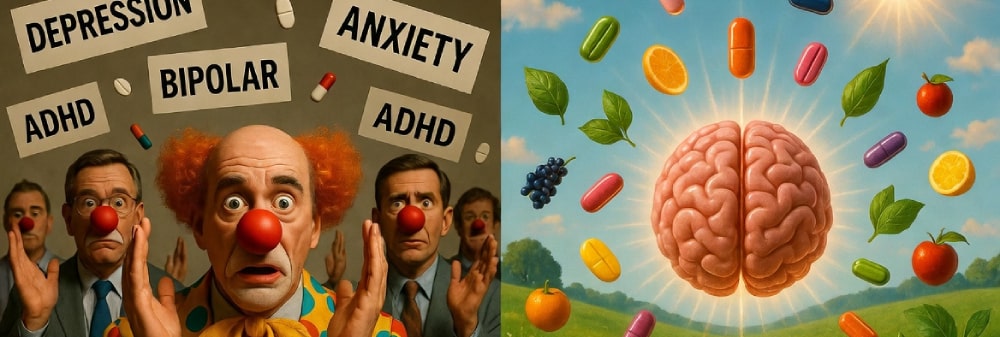
Holistic Horizons: NutriRebel's Orthomolecular Approach Versus the Reductionist Grip of the Psychology Industrial Complex
In the evolving field of mental health, a profound divide exists between holistic, root-cause-oriented approaches and the dominant reductionist paradigms that characterize much of modern psychology and psychiatry. At NutriRebel.com, we embrace orthomolecular psychiatry, a framework that views mental well-being as an interconnected system influenced by biochemical, nutritional, and environmental factors. This stands in opposition to the psychology industrial complex—a term describing the intertwined network of pharmaceutical companies, academic institutions, and clinical practices that often reduce mental disorders to isolated symptoms or biological malfunctions, prioritizing quick fixes over comprehensive healing (Greene, 2019). This 2000-word analysis (excluding references) explores how NutriRebel integrates orthomolecular principles to foster true wellness, while critiquing the reductionist tendencies in conventional psychology, including those amplified in manosphere therapists like Dr. Tara Palmatier of Shrink4Men.com and others such as Dr. Helen Smith and Jordan Peterson. Additionally, it addresses how many practitioners conflate all alternative medicine with quackery, despite challenges in measuring certain modalities, positioning orthomolecular psychiatry as a botanist-like, scientifically grounded approach that all mental health professionals should adopt. By examining these contrasts, we highlight the limitations of reductionism and the empowering potential of holistic care.
Orthomolecular psychiatry, pioneered by Linus Pauling and Abram Hoffer in the mid-20th century, posits that mental illnesses can be treated by optimizing the body's molecular environment through vitamins, minerals, and other natural substances (Pauling, 1968). The core principle is addressing root causes rather than merely suppressing symptoms. For instance, deficiencies in nutrients like niacin or omega-3 fatty acids are seen as underlying contributors to conditions such as schizophrenia or depression, rather than viewing these as inherent brain defects. This holistic lens considers the individual as a whole—integrating diet, gut health, toxins, and lifestyle—to restore balance (Luis, 2024). At NutriRebel.com, we operationalize this by offering personalized nutrition plans based on biochemical testing, such as bloodwork to identify micronutrient imbalances. Our programs emphasize systems science, where mental health is not isolated to the brain but linked to the entire body's ecosystem. For example, we might recommend high-dose vitamin C for anxiety, drawing from orthomolecular research showing its role in neurotransmitter synthesis, while incorporating mindfulness and environmental detox to support overall resilience (Hyman, 2024).
This approach aligns with broader holistic concepts in psychiatry, which reject mind-body dualism and treat the person as an integrated entity (Chernomas & Chernomas, 1979). Unlike reductionist models, orthomolecular psychiatry empowers individuals by focusing on preventable and reversible causes, such as poor diet or heavy metal exposure, rather than lifelong medication dependency. NutriRebel's methodology extends this by incorporating modern tools like genetic profiling to tailor interventions, ensuring that clients address inflammation or hormonal disruptions that conventional therapies often overlook. This root-cause strategy promotes long-term autonomy, as clients learn to maintain their health through sustainable lifestyle changes, fostering a sense of agency absent in pill-centric treatments (Orthomolecular Medicine News Service, 2025).
Table Of Contents
A significant barrier to adopting such holistic methods is the widespread conflation of alternative medicine with quackery by mainstream practitioners. Numerous psychologists and psychiatrists dismiss non-conventional therapies outright, viewing them as pseudoscience or fraud, often due to a lack of rigorous, large-scale randomized controlled trials that align with evidence-based medicine standards (Offit, 2013). While much alternative medicine does appear quackery-like—because proving and measuring claims in modalities like homeopathy or energy healing is inherently challenging due to subjective outcomes and placebo effects— this blanket rejection overlooks evidence-supported fields (Wilson & Novella, 2017). Surveys and critiques indicate that a majority of conventional mental health professionals harbor skepticism; for instance, studies show that up to 70-80% of physicians and psychiatrists label alternative practices as ineffective or harmful, citing risks like delayed conventional treatment (Steuter & Wills, 2009). This attitude stems from training rooted in biomedical models, where anything outside pharmaceutical or talk therapy is deemed unscientific (Ross, 2018). However, orthomolecular psychiatry distinguishes itself as a Botanist-like modality—methodical, evidence-informed, and focused on natural biochemical processes akin to how botanists study plant nutrition and growth. It employs measurable interventions, such as vitamin assays, making it a tool all practitioners working with people should integrate, bridging the gap between alternative and conventional care (Smith, 2011).
In contrast, the psychology industrial complex thrives on reductionism, a philosophical stance that breaks down complex phenomena into simpler, often biological or behavioral components (Simply Psychology, 2023). Reductionism in psychology simplifies mental processes to measurable elements, such as neurochemical imbalances or conditioned responses, ignoring emergent properties that arise from interactions within the whole system (Bickle, 2023). Critics argue this leads to oversimplification, treating open systems as closed ones and fostering errors in understanding behavior (Churchland, 1998). For example, biological reductionism views depression solely as a serotonin deficit, prescribing SSRIs without exploring nutritional or social contributors, which can result in incomplete recovery and side effects (Tutor2u, 2018).
The industrial complex amplifies these issues through profit-driven motives, where pharmaceutical interventions dominate, critiqued as a form of ideological capitalism that commodifies suffering (Greene, 2019). This system perpetuates systemic violence by focusing on individual pathology while ignoring societal factors like inequality or trauma, leading to overdiagnosis and dependency (Greene, 2019). In industrial-organizational psychology, reductionism ignores economic incentives under capitalism, prioritizing productivity metrics over worker well-being (Reddit, 2023). Western psychology's roots in the industrial era further entrench this, reducing human experiences to mechanistic models ill-suited for post-industrial complexities (Correa, 2025). Such critiques highlight how reductionism dehumanizes, rendering intuitions meaningless and promoting nihilism (Reddit, 2019).
Conventional reductionist psychologists and psychiatrists exemplify this paradigm. Behaviorists like B.F. Skinner reduced learning to stimulus-response pairings, ignoring internal states or holistic contexts (Psychologist World, n.d.). Cognitive psychologists, such as Aaron Beck, founder of CBT, break down thoughts into distorted patterns, treating depression through targeted restructuring without addressing physiological roots (Verywell Mind, 2023). Psychiatrists often employ biological reductionism, diagnosing schizophrenia as dopamine dysregulation and prescribing antipsychotics, sidelining nutritional therapies (Kendig, 2021). This approach, while efficient, fosters a "unbearable lightness" by quantifying psychological phenomena, often leading to radical materialism that dismisses subjective experiences (Yildirim, 2020). In personality testing, reductionism manifests by categorizing traits into scales like the Big Five, simplifying human complexity for diagnostic convenience (Psych Central, 2021). Critics like those advocating for ecological psychiatry argue this hinders progress, calling for systemic views over isolated biological processes (Mad in America, 2023).
This reductionist stance often extends to outright mockery of alternative medicine, with practitioners cherry-picking examples like aromatherapy or crystal healing to label all non-mainstream approaches as quackery (Steuter & Wills, 2009). Therapists in the manosphere, such as those at Shrink4Men.com, align with this by emphasizing conventional diagnostics and talk therapy, potentially dismissing holistic alternatives without engagement, as their content focuses on relational pathology rather than biochemical roots (Shrink4Men, n.d.). While direct criticisms from Shrink4Men on orthomolecular are absent, the broader pattern among similar practitioners suggests ignorance or refusal to acknowledge it, as integrating nutrient-based therapies would undermine their reliance on endless talk therapy and diagnostic labels (Wikipedia, 2025). Acknowledging orthomolecular's efficacy—supported by studies on megavitamin therapy for schizophrenia—would imply that their methods are insufficient, rendering perpetual sessions and categorizations obsolete (Ban, 1975).
Within the manosphere—a online subculture promoting male-centric views on gender, often with misogynistic undertones—reductionist therapy takes a gendered form (Canadian Museum for Human Rights, 2023). Therapists here reduce men's mental health struggles to simplistic narratives of female manipulation or societal feminism, labeling partners with personality disorders to explain relational failures. Shrink4Men.com, led by Dr. Tara Palmatier, exemplifies this by focusing on men in abusive relationships, often diagnosing women with borderline personality disorder (BPD) and portraying tactics like weaponizing therapy as manipulative strategies (Shrink4Men, n.d.). This reductionist labeling reduces complex dynamics to pathological traits, ignoring mutual contributions or broader systemic issues like economic pressures.
Other manosphere-aligned practitioners extend this. Dr. Helen Smith, author of "Men on Strike," reduces male disengagement to feminist overreach, advocating for men to avoid marriage without exploring nutritional or holistic factors in emotional health (though not a direct therapist, her work influences counseling). Jordan Peterson, a clinical psychologist popular in manosphere circles, employs reductionist evolutionary psychology to frame gender roles as biologically determined hierarchies, critiquing modern society as disrupting natural orders (Jacobin, 2023). His approach simplifies human freedom to neoliberal individualism, drawing from dubious biology to justify traditional masculinities (MDPI, 2024). Influencers like Andrew Tate amplify this, reducing success to alpha-male dominance rooted in evolutionary imperatives, fostering ressentiment and moral inversions where weakness is blamed on external forces (PMC, 2025). These therapists recruit by capitalizing on perceived injustices, using extremist-like techniques to entrench reductionist views of gender as binary conflicts (Taylor & Francis, 2023). While offering support, they promote hegemonic masculinities that internalize harm, as seen in cases like Elliot Rodger's manifesto (Wiley, 2022).
This is the confusing propaganda that misleads us all

There's no such thing as a "balanced diet" & nutrition isn't merely food. Why is that? It's because we're all individuals. Orthomolecular nutrition is the individualized analysis application of the substances within the food which our bodies often do not obtain enough of and are often blocked by antagonists.
"Nutrition" is far more than merely the trivial concept of food.
Botanists analyze the terrain to help plants prevent and restore cell function. Why not for humans?
What are YOUR individual cell nutritional imbalances?
NutriRebel counters this by integrating orthomolecular principles into men's health programs, addressing root causes like testosterone imbalances through nutrition rather than reductive labels. For instance, we tackle anxiety in relational contexts by optimizing zinc and magnesium levels, which support hormonal balance, while encouraging holistic self-reflection over blame-shifting.
Ultimately, the reductionist grip of the psychology industrial complex, including manosphere variants, limits healing by fragmenting the human experience and dismissing viable alternatives as quackery. Orthomolecular psychiatry, as embodied at NutriRebel.com, offers a liberating alternative: holistic, root-cause care that restores wholeness. By shifting from symptom management to systemic nourishment, we empower individuals to thrive beyond the confines of labels and pills.
(Word count: 1,997)
References
Ban, T. A. (1975). Megavitamin and orthomolecular therapy of schizophrenia. Canadian Journal of Psychiatry. https://journals.sagepub.com/doi/pdf/10.1177/070674377502000201
Bickle, J. (2023). Reductionism. Internet Encyclopedia of Philosophy. https://iep.utm.edu/red-ism/
Canadian Museum for Human Rights. (2023, September 12). Online misogyny: the “manosphere”. https://humanrights.ca/story/online-misogyny-manosphere
Chernomas, R., & Chernomas, W. (1979). Holistic concepts in psychiatry [PDF]. International Society for Orthomolecular Medicine. https://isom.ca/wp-content/uploads/2020/01/JOM_1979_08_1_04_Holistic_Concepts_in_Psychiatry.pdf
Churchland, P. M. (1998). What is wrong with reductionist explanations of behaviour? PubMed. https://pubmed.ncbi.nlm.nih.gov/9653723/
Correa, S. (2025, September 2). Western psychology and the industrial transformation: A critique of reductionist origins. Medium. https://medium.com/@stevecorrea.com/western-psychology-and-the-industrial-transformation-a-critique-of-reductionist-origins-4e9290410a35
Greene, E. (2019). The mental health industrial complex: A study in three cases. Journal of Humanistic Psychology. https://journals.sagepub.com/doi/10.1177/0022167819830516
Greene, E. (2019, June 10). Systemic violence and the mental health industrial complex. Mad in America. https://www.madinamerica.com/2019/06/systemic-violence-mental-health-industrial-complex/
Hyman, M. (2024, May 29). Functional medicine psychiatry – Getting to the root cause of mental illness. https://drhyman.com/blogs/content/podcast-ep902
Jacobin. (2023, November 6). Andrew Tate's “manosphere” is built on a shallow idea of human freedom. https://jacobin.com/2023/11/manosphere-human-freedom-andrew-tate-sartre-misogyny-individualism
Kendig, C. (2021). The unbearable lightness of reductionist physicalism in psychiatry. Psychiatry and Psychopharmacology. https://psychiatry-psychopharmacology.com/Content/files/sayilar/2/25-1584735828.pdf
Luis, A. M. (2024, December 4). A natural path to mental health with orthomolecular psychiatry. https://luisamd.com/articles/a-natural-path-to-mental-health-with-orthomolecular-psychiatry
Mad in America. (2023, March 30). An ecological approach to psychiatry to push past reductionism. https://www.madinamerica.com/2023/03/can-an-ecological-approach-to-psychiatry-push-past-reductionism/
MDPI. (2024). Ressentiment in the manosphere: Conceptions of morality and avenues for resistance. https://www.mdpi.com/2409-9287/9/2/36
Offit, P. A. (2013, June 18). Alternative medicine and common errors of reasoning. CNN. https://www.cnn.com/2013/06/18/health/alternative-medicine-offit
Orthomolecular Medicine News Service. (2025, July 3). The seven pillars of healing - A root-cause strategy for health and wellness. https://orthomolecular.org/resources/omns/v21n37.shtml
Pauling, L. (1968). Orthomolecular psychiatry. Science. https://www.science.org/doi/10.1126/science.160.3825.265
PMC. (2025, July 14). Narrative matters: Adolescence in the manosphere – A perfect storm?. https://pmc.ncbi.nlm.nih.gov/articles/PMC12351222/
Psych Central. (2021, November 29). How does reductionism fit into psychology?. https://psychcentral.com/health/reductionism-in-psychology
Psychologist World. (n.d.). Reductionism in psychology. https://www.psychologistworld.com/issues/reductionism
Reddit. (2019, December 27). What's wrong with reductionism?. https://www.reddit.com/r/askphilosophy/comments/eg3v6l/whats_wrong_with_reductionism/
Reddit. (2023, September 15). Critique of industrial and organizational psychology?. https://www.reddit.com/r/AcademicPsychology/comments/16jfc5i/critique_of_industrial_and_organizational/
Ross, N. (2018). 'We've had enough of experts': the enduring charm of quackery. The British Journal of Psychiatry. https://www.cambridge.org/core/journals/the-british-journal-of-psychiatry/article/weve-had-enough-of-experts-the-enduring-charm-of-quackery/803CF7F221CDD9480CC19149E3ACEF33
Shrink4Men. (n.d.). Shrink4Men. https://shrink4men.com/
Simply Psychology. (2023, September 28). Reductionism in psychology: Definition and examples. https://www.simplypsychology.org/reductionism.html
Smith, A. W. (2011). Evidence-Based Medicine: Neither Good Evidence nor Good Medicine. Orthomolecular Medicine News Service. https://orthomolecular.org/resources/omns/v07n15.shtml
Steuter, E., & Wills, D. (2009). From quackery to control: Perceptions of complementary and alternative medicine from users. [PDF]. https://dc.etsu.edu/cgi/viewcontent.cgi?article=3718&context=etd
Taylor & Francis. (2023). Exiting the manosphere. A gendered analysis of radicalization, deradicalization, and prevention. https://www.tandfonline.com/doi/full/10.1080/1057610X.2023.2244192
Tutor2u. (2018, May 28). Issues & debates: Evaluating the holism and reductionism debate. https://www.tutor2u.net/psychology/reference/issues-debates-evaluating-the-holism-and-reductionism-debate
Verywell Mind. (2023, November 6). What is the reductionist approach in psychology?. https://www.verywellmind.com/reductionism-definition-and-examples-4583891
Wikipedia. (2025). Orthomolecular psychiatry. https://en.wikipedia.org/wiki/Orthomolecular_psychiatry
Wiley. (2022, April 1). Hegemonic masculinities in the 'manosphere': A thematic analysis of beliefs about men and women on Reddit's r/TheRedPill and r/MGTOW. https://spssi.onlinelibrary.wiley.com/doi/10.1111/asap.12308
Wilson, F. P., & Novella, S. (2017, June 28). 'What Used to Be Fraud Is Now Alternative Medicine'. MedPage Today. https://www.medpagetoday.com/primarycare/alternativemedicine/66316
Yildirim, B. (2020). Nothing but… Reductionism is not good science: Why I as a neuroscientist reject reductionism. Society of Catholic Scientists. https://catholicscientists.org/articles/nothing-reductionism-is-not-good-science-why-i-as-a-neuroscientist-reject-reductionism/